
-
What is multilevel marketing (MLM)?
Multilevel marketing, also known as network marketing, is a distribution system in which companies sell their products or services directly to the end consumer. The special feature: sales partners earn not only through their own product sales, but also through the sales of their „downline,“ meaning the partners they have recruited themselves. This means that partners in an MLM profit both from their own sales and from those of their recruits.
The difference between legal MLM and illegal pyramid or snowshoe schemes
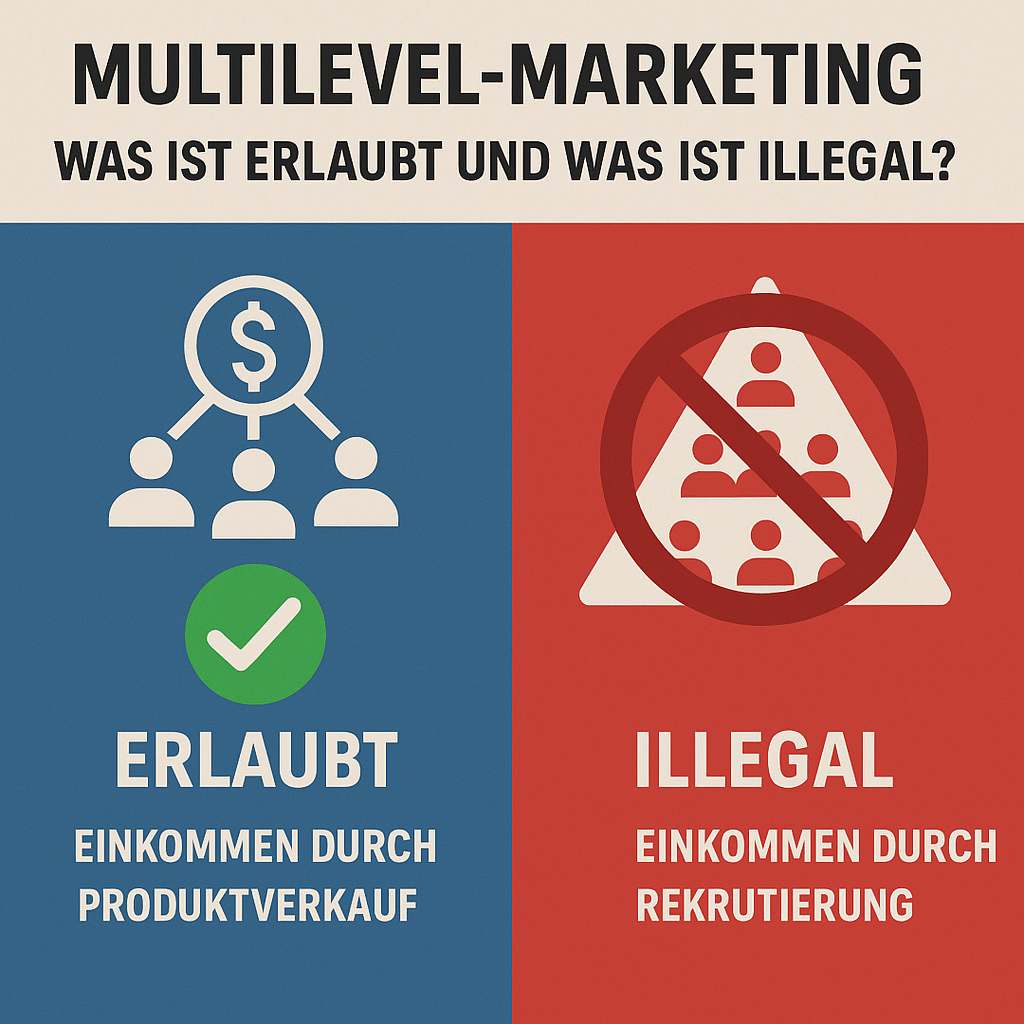
Not every MLM is illegal. The difference between a legal MLM and an illegal pyramid or ponzi scheme lies primarily in the product portfolio and the source of income. In a legal MLM, income is based on the sale of real products or services, whereas in illegal systems, income is generated primarily through the recruitment of new members. In illegal systems, the product is often offered only as a pretext or at a heavily inflated price that is uncharacteristic of the market.
Characteristics of an illegal pyramid or ponzi scheme
- High initial costsIn illegal systems, new members often have to pay high entry costs (e.g., by purchasing „test assortments“) or place orders that offer no realistic prospect of profit.
- Focus on recruiting instead of sellingIn an illegal system, the recruitment of new members is prioritized over the sale of products. Profits come almost exclusively from recruiting new members.
- Unrealistic income promisesPyramid or snowball schemes often lure people in with unrealistic promises of getting rich quickly and with little effort. However, these promises are usually based solely on recruiting new participants and not on actual sales performance.
- Missing or worthless productsAnother feature of illegal systems is the lack of real products or services. Sometimes products are only sold at inflated prices without offering real value to the end consumer.
Why are pyramid or ponzi schemes illegal?
Pyramid and snowball schemes are illegal because they do not provide a sustainable economic foundation. The participants' profits are not based on genuine sales or services, but on the recruitment of new members. This leads to an unstable business model that often results in only the participants at the top of the pyramid profiting, while the majority of participants suffer losses.
In many countries, including Austria, Germany, and the USA, pyramid and snowball systems are prohibited by legislation. In Austria, such systems are covered by the Act against Unfair Competition (UWG) and the Criminal Code (StGB). Participation as a „partner“ in illegal MLM systems can therefore entail criminal and civil legal consequences.
Characteristics of a legal MLM
A legal MLM is based on the sale of real, marketable products or services. This is how you recognize a reputable MLM:
- Product orientationIn a reputable MLM, the focus is on selling real products or services that can be sold at a market-standard price.
- Transparent income structureA legal MLM offers a clear and fair compensation structure based on actual sales figures and not just on the recruitment of new members.
- No unrealistic promisesA reputable MLM does not make exaggerated promises regarding income potential. The income is realistic measured against the time invested and is based on sales performance and team building.
Why is it important to distinguish between legal MLM and illegal systems?
While MLMs with a genuine product sales focus can provide a legal source of income, pyramid schemes pose a high risk because they are based on fraud and illegal business practices. Distinguishing between a legitimate MLM and an illegal pyramid scheme is crucial to avoid financial losses, civil liabilities, reputational damage, or even imprisonment.
Conclusion: MLM yes, but with caution!
Multilevel marketing can be a profitable business model if done right. However, it is important to make sure that you do not find yourself in an illegal pyramid or ponzi scheme. Make sure that the focus on products is clearly in the foreground, that the income structures are transparent and fair, and that no unrealistic promises are made.
Before entering an MLM business, it is best to have the company and its structure thoroughly reviewed by a lawyer. Only through a legally sound review can you ensure in advance that you are investing in a legal, sustainable, and ethical business model and that you do not have to expect unexpected criminal consequences.
Should it happen for whatever reason that you were part of an illegal MLM system, legal representation is strongly recommended already during the criminal investigation proceedings, preferably right at the first police interrogation.
For further information and individual consultation, Roman Taudes and his team are at your disposal at any time. Contact us at office@atb.law or by phone at +43 1 3912345.