
-
Consulting agreement as a fundamental prerequisite
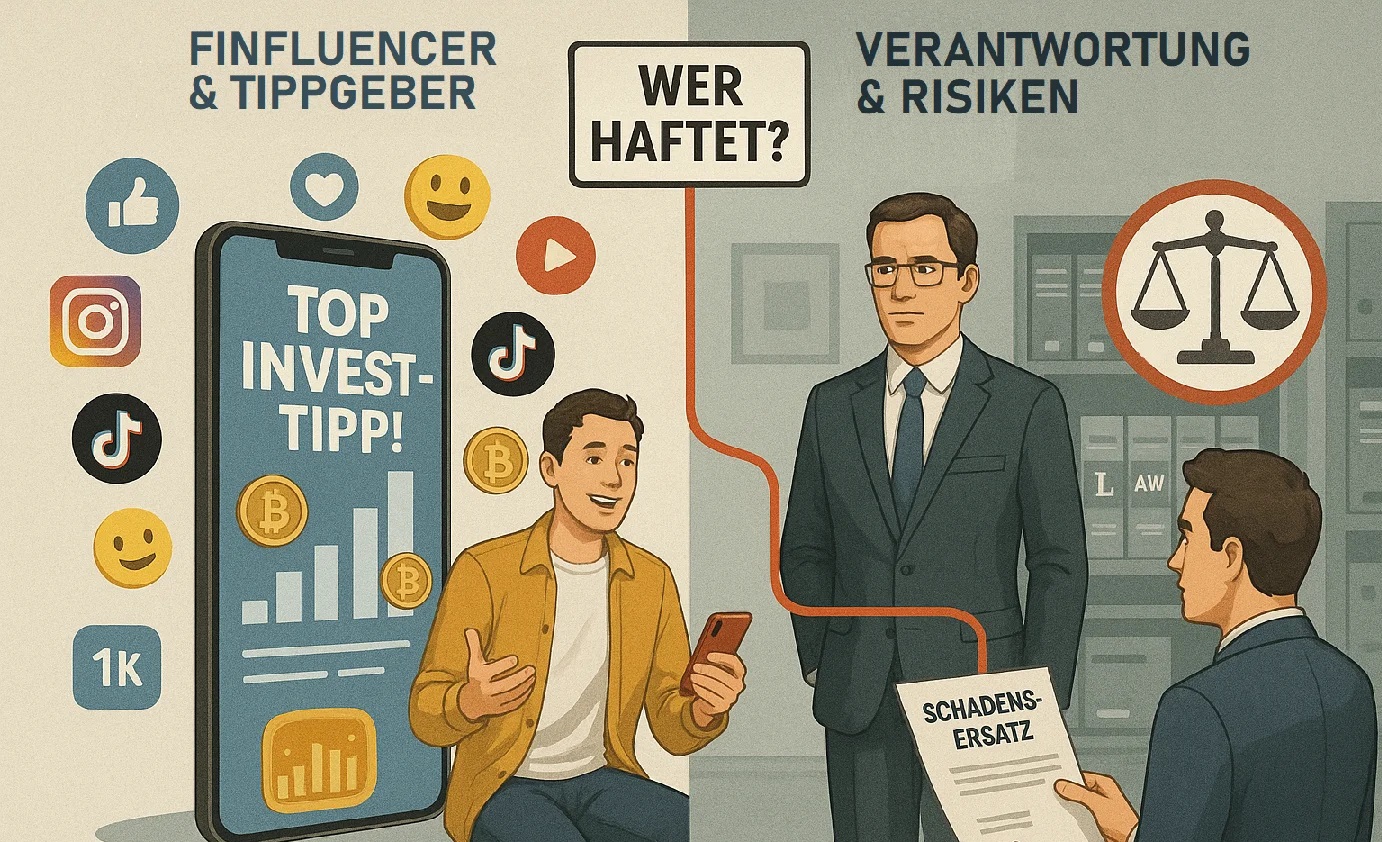
The fundamental prerequisite for liability for poor advice is always, in the first step, the existence of an advisory contract or an advisory duty. According to established case law, a financial advisory contract is concluded quickly, as such a conclusion can also occur implicitly. It may already be sufficient if the tipster or „finfluencer“ recommends a specific product of the financial service provider to the (potential) customer or makes concrete recommendations regarding the investment amount. Whether the "advisor" actually possesses the personal and professional knowledge or regulatory requirements is irrelevant for liability for damages due to poor advice. These qualities are invariably assumed in the case of paid advice. Consequently, even a person not authorized to provide investment advice must observe the corresponding standard of care and conduct rules within the scope of unauthorized advisory services.
Liability attribution of the tipster
The referral business is characterized by the fact that the referrer transmits the contact details of interested persons (i.e., potential customers) to a business and receives a so-called „referral commission“ as compensation for doing so. The referrer supports businesses in acquiring customers without providing any advisory or brokerage service beyond the mere supply of customers. If the referrer at most independently provides faulty or incomplete investment advice, their conduct can be attributed to the financial service provider pursuant to Section 1313a of the Austrian General Civil Code (ABGB) in accordance with recent case law of the Supreme Court (OGH) in case 17 Ob 8/23k. The financial service provider is then directly liable to the injured customer if the referrer
- was acting in the pursuit of the financial service provider's interests and
- his behavior does not fall outside the general scope of the tasks that the tipster had to perform as part of pursuing the financial service provider's interests.
The financial service provider is therefore generally liable for incorrect advice or other brokerage services provided by the tipster if the financial service provider itself was at least formally authorized to provide investment advice or investment brokerage at that time. A prerequisite for liability is, of course, always that incorrect or incomplete investment advice was actually given.
Liability attribution of the finfluencer
Finfluencers are individuals who share content related to financial topics on social media. These topics include tips on structuring personal financial planning, investment recommendations, and information on macroeconomic or geopolitical events. Whether or not a finfluencer holds the relevant formal education or certifications in the financial sector is generally not recognizable to the typical retail investor.
Financial service providers that promote their products via finfluencers on social networks or other platforms run the risk of potentially being held liable for customer damages in the future. If a finfluencer—even if acting unilaterally—provides advice in addition to the objective promotion of an investment product that takes into account the personal and financial circumstances of other individuals or target groups, it is likely to be considered investment advice.
Although the attribution of liability for the misconduct of finfluencers to financial service providers has not yet been the subject of supreme court jurisprudence, it follows the principles already outlined regarding tipsters.
Get legal information in advance to avoid future liability cases
For financial service providers, the use of tipsters and finfluencers in sales brings specific advantages but also challenges. Above all, contractual structuring, legally sound training of intermediaries involved in sales, and ongoing compliance checks are essential to protect customers and the company from the consequences of incomplete or erroneous advice.
For further information and individual consultation, Roman Taudes and his team are at your disposal at any time. Contact us at office@atb.law or by phone at +43 1 3912345.