
The Ransomware Reality: Almost Daily Attacks as the „New Normal“
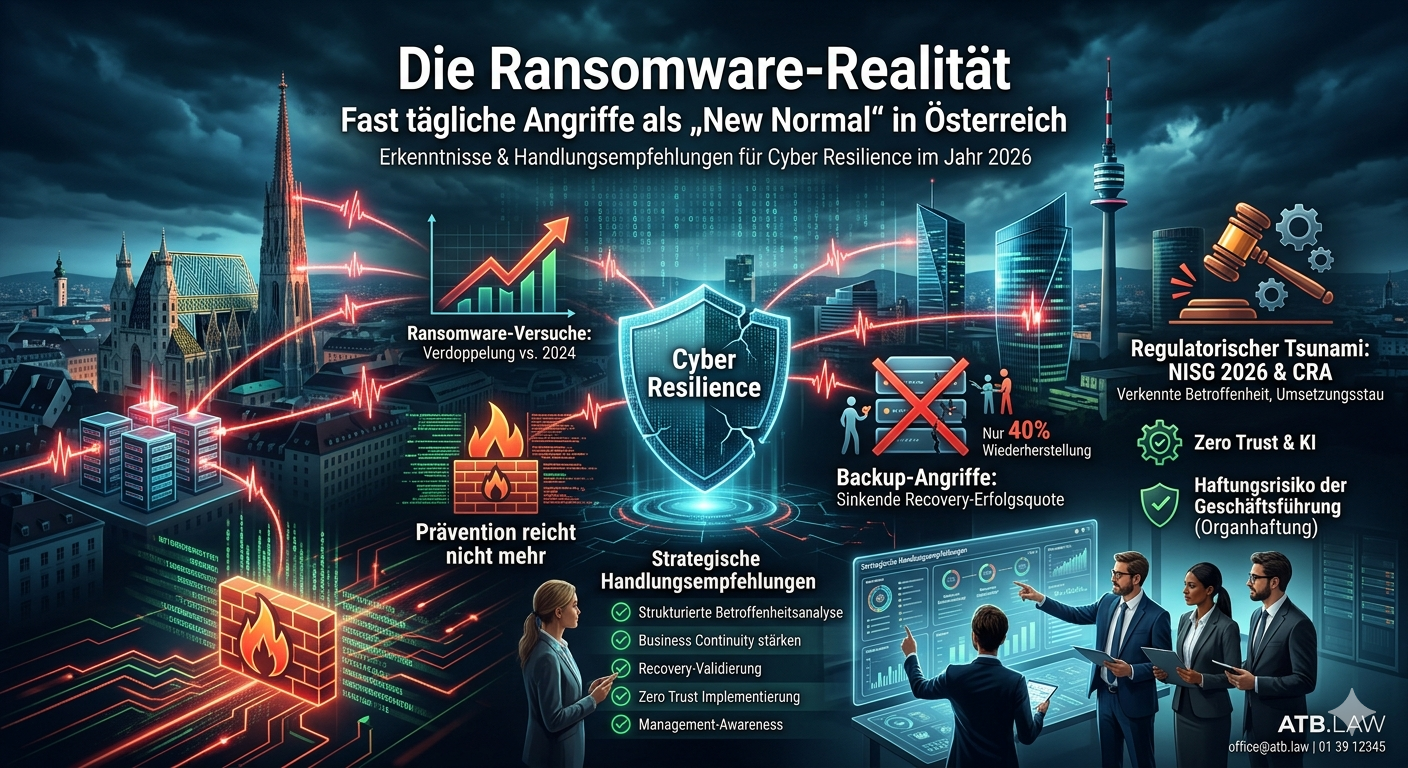
The professionalization of attackers is progressing inexorably. According to the latest report, nearly one-third of the companies surveyed (28 %) report that almost daily ransomware attack attempts. That is more than a doubling compared to the year 2024.
Why defense alone is no longer enough
Although 80 % of companies are able to prevent the spread of malware through technical infrastructure measures, but the impacts are getting closer. When the barriers are breached, the consequences are often devastating:
-
Business shutdown: Two-thirds of companies (66 %) cannot rule out a total shutdown lasting several weeks as a result of an attack.
-
Existential threat: Particularly at risk are highly automated businesses and companies with just-in-time production..
Legal Notice: From the perspective of corporate liability, awareness of this threat situation is crucial. Managing directors who fail to safeguard business continuity through appropriate emergency plans risk personal liability consequences in an emergency, as the duty of care increases in light of the known risk situation.
The Technical Dilemma: When the Backup Becomes a Trap
One of the most concerning findings of the Deloitte Cyber Security Report 2026 regarding data recovery. The ability to successfully recover data after encryption has dropped massively.
-
Success rate is dropping: Only 40 % of the affected companies were able to recover data from a backup; decryption was successful in only 23 % of the cases.
-
Attack on the lifelines: Modern ransomware now specifically targets backup environments. If the backup itself is encrypted or deleted, the company is left with nothing.
-
Governance gap: The report shows increasing uncertainty as to whether backups will work in an emergency. Many organizations lack regular, documented testing..
For a modern Cyber Resilience In Austria, it is therefore essential to invest not only in „locks“ (prevention), but in „fire departments“ (recovery).
NISG 2026 & Regulation: The Underestimated Danger of Ignorance
Austrian companies are facing a regulatory tsunami. However, their self-assessment of the impact often diverges drastically from the legal reality.
Impact often misjudged
Many companies are unsure whether central guidelines such as NIS2 (NISG 2026), the Cyber Resilience Act (CRA) or the AI Act applicable to them.
-
Only 22 % of companies classify themselves as critical infrastructure under NIS2.
-
At AI Act Only 27 % are affected.
This uncertainty is risky. The NISG 2026 provides comprehensive risk management measures and strict reporting obligations for security incidents for affected companies. Anyone who fails to recognize their own affectedness will miss important implementation deadlines and risk severe penalties..
Implementation backlog for NIS2
Among the companies that are aware of how this affects them, only 23 % have completed all preparations. More than half are still in the implementation phase. Given the complexity of these projects, this is a warning signal for Austria as a business location.
Zero Trust and AI: Hype vs. Necessary Strategy
The report also highlights technological approaches that are crucial for security in 2026.
Zero Trust Austria: Farewell to blanket trust
The „Never Trust, Always Verify“ principle is establishing itself. The number of companies that have never Zero Trust have heard, has halved within two years. Currently, 35 % companies are already implementing zero-trust strategies. Advantage: Zero Trust not only reduces risk, but also complexity through standardized access processes.
AI in Cyber Security: A Double-Edged Sword
Artificial intelligence (AI) already plays a central role in cybersecurity at 11 % of companies. It is most commonly used for phishing detection (52 %) and in awareness training (57 %). At the same time, however, attackers are also using AI to scale attacks and create deceptively authentic phishing emails. The use of AI must therefore be carefully considered and gradually integrated into existing governance.
The Resource Trap: Increasing Pressure on Stagnant Budgets
Despite the dramatically increased threat level, 60 % of companies plan to keep their budgets for cybersecurity technology at the same level as last year. As for personnel expenses, as many as 69 % do not intend to increase them.
From a legal perspective, this is problematic: if the threat level increases (fact) and regulatory requirements grow (law), a constant budget can quickly lead to organizational liability. Investments in cybersecurity will not be an „optional service“ in 2026, but rather a corporate necessity to ensure survival..
Strategic recommendations for Austrian companies
To meet the challenges of Cyber Security Report 2026 to counter, we recommend the following steps:
-
Structured impact analysis: Check immediately whether your company falls under the NISG 2026, the Cyber Resilience Act or the AI Act falls. Do not rely on your gut feeling.
-
Strengthening Business Continuity Management (BCM): Assume that an attack will be successful. Create robust emergency plans and conduct regular exercises (tabletop exercises).
-
Recovery Validation: Test your backups. Make sure your data recovery works even if the primary systems are compromised.
-
Implementing Zero Trust: Begin the step-by-step implementation of a zero-trust architecture to prevent the lateral movement of attackers in your network..
-
Management Awareness Cyber risks are business risks. Management must actively assume responsibility for cyber resilience and prioritize budgets according to the actual risk profile.
FAQ: Frequently Asked Questions about the Cyber Security Report 2026 & NISG 2026
Who is affected by the NISG 2026 in Austria?
The NISG 2026 affects a multitude of sectors, including energy, transport, banking, healthcare, digital infrastructure, as well as sectors such as food, waste management, and manufacturing. Classification is often based on thresholds (company size/revenue). An individual assessment is strictly required.
What penalties apply for violations of the NISG 2026?
The sanctions are based on the EU's NIS2 framework. Severe fines are looming, which can be based on the company's global turnover. In addition, the personal liability of management bodies is coming into sharper focus.
Why has data recovery become more difficult in 2026?
Modern ransomware groups operate with a high degree of professionalism. They no longer just encrypt working data, but purposefully corrupt backups and shadow copies to eliminate companies' only rescue option..
Conclusion: Resilience is not a state, but a process
The Cyber Security Report 2026 Austria is a wake-up call. The high level of subjective security felt by many companies (66 % feel secure) stands in stark contrast to the declining recovery capability and the increasing frequency of attacks.
The legal support of cyber security strategies and preparation for regulatory audits are essential today to minimize liability risks and ensure the continued existence of the company.
Do you need support with NISG 2026 readiness or legal assistance after or during a cyber incident?
ATB.LAW supports you with regulatory impact analysis, the legal protection of your incident response plans, and communication with authorities. For further information, Roman Taudes and his team at any time at office@atb.law or by phone at 01 39 12345 available.


